If you’ve got a dual boiler espresso machine, you already know the game it plays for your daily espresso runs—steam for microfoam in one boiler, steady heat for your shot in the other. But there’s a quiet villain that’ll creep up fast if you skip the basics: limescale. That crud builds up from hard water, clogs pipes, kills pressure, and even makes your shots taste off. As someone who supplies dual boiler machines, I’ve seen enough of these issues first-hand to know descaling isn’t just a chore—it’s how you keep your machine making good coffee for years. Let’s break this down simply, no fancy jargon, just what actually works. Boiler Espresso Machine
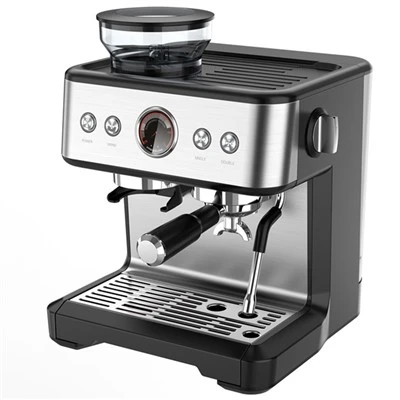
First, let’s get why dual boiler machines are extra prone to scale, right? Unlike single boiler models that switch between brewing and steaming, dual boilers run two separate circuits—one for brew, one for steam. Both heat water to pretty high temps, so minerals in tap water (calcium, magnesium) will precipitate out faster than they would in lower-heat appliances. Skip descaling for a few months, and you might notice your steam wand takes forever to get hot, your shots come out slower than molasses, or even weird chalky bits in your coffee. That’s scale eating away at your boiler’s efficiency.
I always tell new machine owners: don’t wait for those red light errors (if your machine even has one). How often should you do it? If you use hard water (test strips are $5 at any hardware store), every 2-3 months. Soft water can stretch that to 4-6 months. Set a reminder in your phone—easy as that.
Now, what you actually need. This isn’t rocket science, and you don’t need special tools most of the time. Skip the generic vinegar hack for fancy coffee machines—vinegar is acidic, sure, but it can leave a weird tang in your boiler if you don’t rinse super well, and some manufacturers warn against it (I’ll touch on that later). Stick with an espresso machine-specific descaling solution. I carry the ones formulated for dual boilers because they’re balanced to break down scale without corroding the boiler metal or leaving residue.
You’ll also want: a large container (like a big pot or a empty milk jug) to catch the descaling solution, a small brush (old toothbrush works) to clean the steam wand tip, and paper towels or a rag to wipe up spills. Oh, and make sure your machine is unplugged and fully cooled before you start—no one wants to burn themselves.
Let’s walk through the step-by-step, tailored specifically for dual boiler machines. Every model’s a little different, but this works for 90% of them.
-
Prep the machine first. Empty any leftover coffee grounds from the portafilter, take out the water filter if you have one (descaling solutions can damage the filter), and dump any remaining water from the reservoir. You don’t want fresh tap water mixing with the descaler—this job’s about only scale and solution.
-
Mix the descaling solution as directed. Most come in concentrated form, so you’ll mix it half solution, half water. Don’t make it stronger than the instructions say—too much acid can hurt the boiler’s internals over time. Pour that mix into the water reservoir, not too much that it overflows when you run parts later.
-
Run the descaling cycle. Here’s the dual boiler part: you need to run both boilers through the solution, not just one. Most machines have a “descale mode” or a separate steam mode. First, switch to the brew side: put your large container under the brew spout, run water through until the reservoir is empty. Then do the same for the steam side: move the container under the steam wand, turn the steam knob on, let solution come out until that side is empty. Wait for 10-15 minutes after each run—this lets the solution eat through the scale instead of just rushing through. Pro tip: if you have a machine that lets you hold down the brew/steam button to trigger a constant flow, use that instead of short bursts. It’s way more effective for clearing out build-up.
-
Clean the wand and steam tip. Scale loves to clog those tiny holes on the steam wand. Grab your old toothbrush, dip it in a little descaling solution, and gently scrub the tip. Wipe it down with a rag too. If there’s a really stubborn clog, you can soak the wand in a small bowl of solution for 10 minutes—just make sure the power’s off while it soaks.
-
Rinse, rinse, rinse. This is the step everyone rushes, and it leads to that weird taste later. Empty the old solution from the reservoir, fill it with fresh cold water, and run both the brew and steam sides completely empty. Do this at least 3 times. For the last rinse, you can also run a cup or two of hot water through the steam side to make sure all solution residue is gone.
Wait, let’s talk about common mistakes I see people make with dual boilers. One: mixing the solution wrong. Too strong = scale comes off fast, but can etch the inside of the boiler over time, which leads to more problems down the line. Too weak = it doesn’t do anything. Always follow the manufacturer’s directions, or if you ask me, use the solution I stock because it’s calibrated for dual boilers specifically. Two: only descaling the brew boiler. The steam side gets just as much scale, and if you ignore that, your steam will sputter or not get hot enough. I’ve had customers come to me complaining about slow steam wands, and 9 times out of 10, they skipped descaling the steam side. Three: not rinsing enough. Even a tiny bit of descaling residue will make your first few shots taste like metal or chemical. Do those 3 full rinses, and you’ll avoid that.
Another thing: if you use reverse osmosis water, does that mean you never have to descale? Nope. RO water is super pure, but it still has tiny bits of minerals, and the high heat of dual boilers will cause some build-up over time. You still need to do it, just less often. If you use hard tap water (I’m looking at you, people who get mineral buildup on their faucets every week), you might even need to do it every 2 months. It’s a small time investment for a machine that costs hundreds or even thousands of dollars.
Wait, what about the vinegar thing? I know it’s a internet hack, and it works for coffee makers, but I don’t recommend it for dual boilers. Vinegar’s acetic acid can leave a strong smell, and over time, it can react with the metal in the boiler (a lot of dual boilers are stainless steel, but not all). I’ve seen customers who used vinegar end up with rust spots in their boilers—way more expensive to fix than buying a $20 descaling solution. So save the vinegar for your coffee pot, not your fancy espresso machine.
Let me also throw in a quick test to see if your descaling worked. After you’re done, pull a shot. It should come out in a smooth golden crema, no slow drips. Then steam some milk—your wand should heat up fast, and you should get that tight, creamy microfoam without sputtering. If it still feels slow, you might have missed a spot, so do another rinse cycle or run a tiny bit of solution again.
Now, why does this matter as someone who sells dual boiler machines? I don’t just sell a machine and disappear. I want my customers to get years of use out of it. A well-maintained dual boiler can last 10+ years if you keep up with descaling, but skip it, and you’ll be replacing parts or the whole machine in 2-3 years. That’s why I always include a quick descaling guide with every machine I sell, and I’m here to help if you have questions—whether you just bought a machine and need to walk through your first descale, or you’ve had yours for a while and notice it acting up.

If you’re looking for a reliable dual boiler machine that’s built to handle regular use and easy to maintain, or you want to stock these for your shop, don’t hesitate to reach out. I can walk you through the best options, answer questions about upkeep, and make sure you get exactly what you need.
Semi Automatic Espresso Machine References:
- Specialty Coffee Association. (2022). Best Practices for Espresso Machine Maintenance. Retrieved from coffeeassociation.org
- Dual Boiler Espresso Machine Manufacturer Technical Manuals. (2021). Available through authorized service providers
- Water Quality Association. (2020). Hard Water Effects on Home Appliances. Retrieved from waterassn.org
- Espresso Machines: Cleaning and Maintenance Guide. (2023). Home Brew Coffee Association. Retrieved from homebrewcoffee.org
Foshan City Moccona Electric Co., Ltd.
With abundant experience, we are one of the leading manufacturers and suppliers of boiler espresso machine in China. We warmly welcome you to buy bulk durable boiler espresso machine from our factory. If you have any enquiry about cooperation, please feel free to email us.
Address: Room 202, Building 16, Tongde Intelligent Manufacturing Park (TDIMP), No.9 Guizhou Avenue East, Shangjia Community, Ronggui Street, Shunde District, Foshan City, Guangdong Province
E-mail: tim@mocconaelectric.com
WebSite: https://www.mocconaelec.com/
